
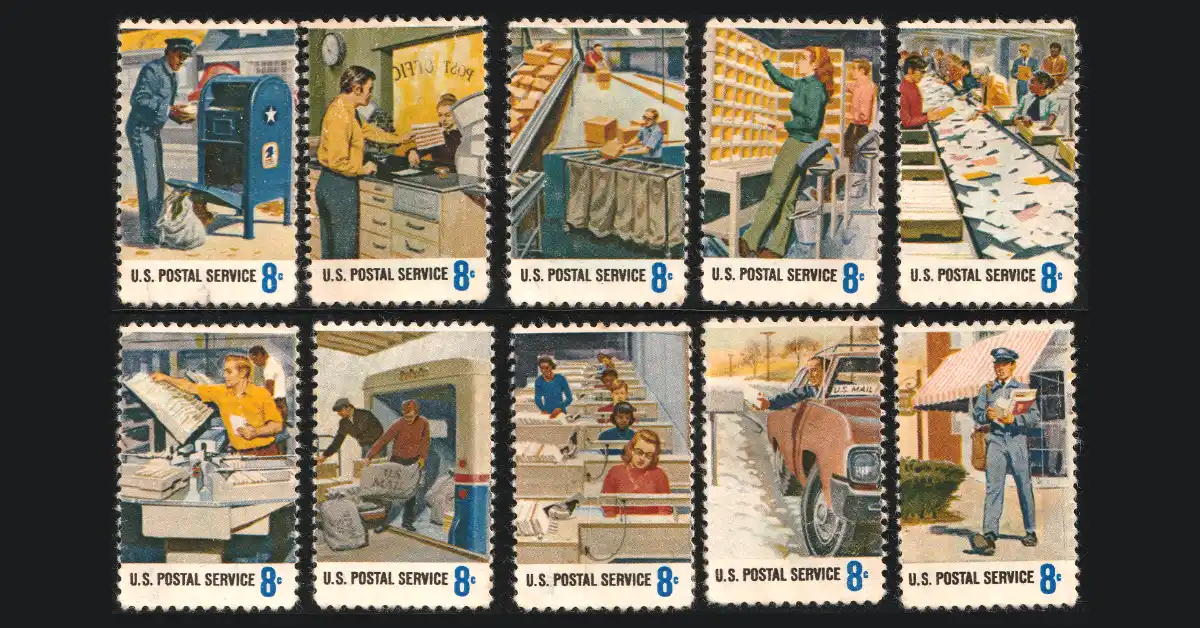
The 1973 Postal Service Employees stamps represent one of the most people-centered commemorative issues in U.S. philately.
Rather than celebrating a single individual or historic event, this issue honored the collective workforce of the United States Postal Service – the letter carriers, clerks, and support staff who ensured uninterrupted mail service during a time of major institutional change.
For collectors, this issue is valued not for rarity, but for its symbolism, design clarity, and historical relevance in the early years of the modern USPS.
Historical Context: USPS in the Early 1970s
The issuance of the Postal Service Employees stamps must be understood in light of a critical transformation in American postal history.
On July 1, 1971, the United States Postal Service (USPS) officially came into being following the Postal Reorganization Act, the result of a four-year reform of the former U.S. Post Office Department.
This reorganization modernized operations, improved labor relations, and redefined the postal system as a service-oriented national institution.
Only two years later, in 1973, the USPS chose to honor its employees – acknowledging that the success of this new organization depended on its people.
Collectors interested in early USPS identity and design evolution may also explore the United States Postal Service stamp depicting Loewy’s iconic USPS logo, issued after the formation of the USPS in 1971.
That issue symbolized the visual and institutional rebirth of the postal service and pairs naturally with the 1973 Postal Service Employees stamps in a thematic collection or exhibit.
Stamp Issue Overview
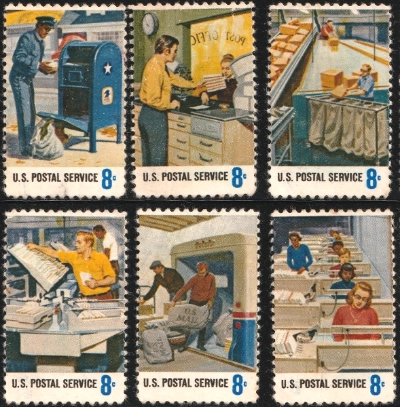
Ten special stamps of 8¢ were issued in 1973 to emphasize the important duties performed by the men and women who are employed by the United States Postal Service.
Each of the 10 stamps depicts one of the many jobs performed by postal workers and contains a message written by the Post Office.
- Year of Issue: 1973
- Issuing Authority: United States Postal Service
- Stamp Type: Commemorative
- Theme: Postal Service Employees
- Intended Use: Regular domestic mail
This issue consisted of multiple designs, each highlighting a different aspect of postal service work.
Stamp Design
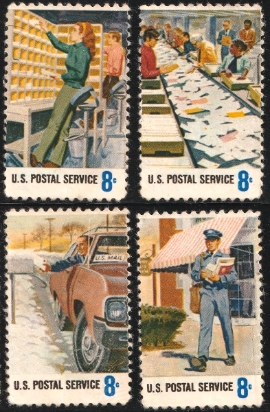
The Letter Carrier
One stamp design depicts a letter carrier, symbolizing the most visible face of the postal service.
The Postal Clerk
Another design focuses on a postal clerk, representing employees who work at post office counters. These stamps acknowledges the vital role clerks play in ensuring mail is correctly processed.
The Mail Processing Employee
This design highlights a mail processing or distribution worker, reflecting the increasingly mechanized postal operations of the 1970s. It subtly references modernization without overshadowing the human element.
The Collective Workforce Design
Some versions emphasize grouped or stylized figures, representing unity rather than a single role. This design reinforces the idea that no single function defines USPS – success comes from collaboration.
The story told by the 1973 Postal Service Employees stamps finds a modern counterpart in the 250 Years of Delivering stamps issued on July 23, 2025, which expand the same theme of dedication and service across the full history of America’s postal system.
Message on the Back of each Stamp
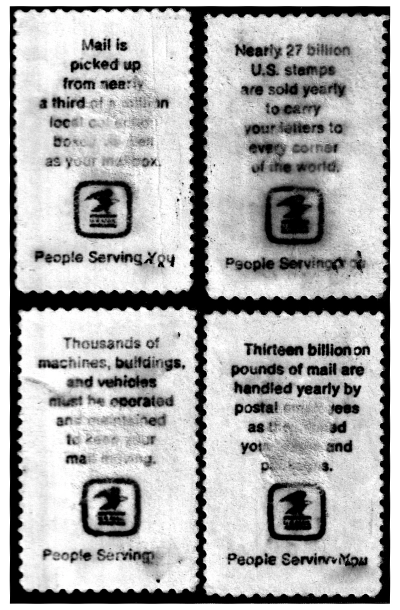
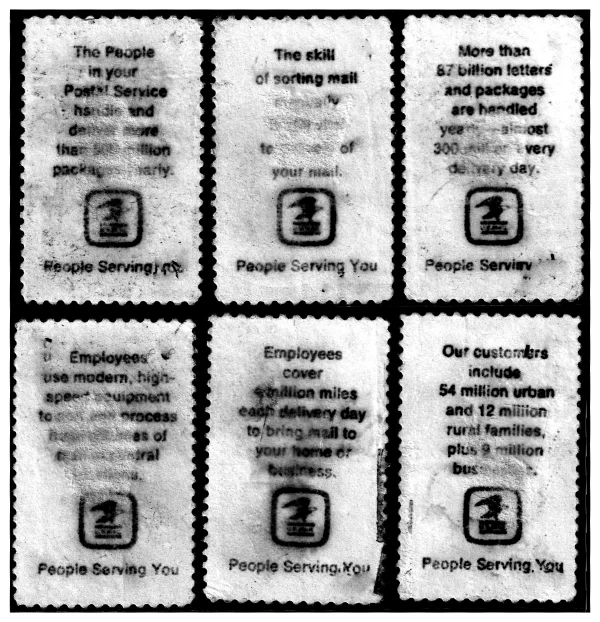
One of the most historically important and often overlooked aspects of the 1973 Postal Service Employees stamps is the informational text and USPS new logo printed on the back of each stamp.
These short messages transformed the issue from a simple commemorative into a public education tool, reinforcing the mission, scale, and human effort behind the newly formed United States Postal Service.
Issued just two years after the USPS officially came into existence in 1971, these messages were carefully crafted to explain what postal employees do, how vast the operation is, and why their work matters – using real statistics that the public could easily understand.
Why the Backing Messages Matter
The backing text served three major purposes:
- Public Awareness – Many Americans used the mail daily but had little idea of the immense system behind it.
- Employee Recognition – The messages validated the skill, labor, and responsibility of postal workers.
- Institutional Confidence – At a time of transition, the USPS used facts to demonstrate reliability, scale, and efficiency.
Each message corresponds directly to a stamp design, creating a narrative link between image and explanation.
Interpretation and Significance of Each Message
Window Clerk
“Nearly 27 billion U.S. stamps are sold yearly to carry your letters to every corner of the world.”
This message highlights the window clerk as the public face of the Postal Service. By emphasizing stamp sales, it connects a simple transaction at the counter to a global communication network. It reinforces the idea that every stamp purchased plays a role in international and domestic connectivity.
Mail Pickup
“Mail is picked up from nearly a third of a million local collection boxes, as well as your own mailbox.”
This text emphasizes accessibility and convenience. It reminds customers that the USPS comes to them – whether through street collection boxes or home mailboxes – illustrating the universal service obligation that defines the Postal Service.
Conveyor Belt
“More than 87 billion letters and packages are handled yearly – almost 300 million every delivery day.”
These staggering numbers convey scale and endurance. The message reassures the public that the USPS is capable of handling enormous daily volumes, underscoring the importance of coordinated systems and trained employees.
Sorting Parcels
“The people in your Postal Service handle and deliver more than 500 million packages yearly.”
Long before the rise of e-commerce, this message acknowledges the growing importance of parcel delivery. It positions USPS employees as essential facilitators of commerce and personal exchange.
Mail Canceling
“Thousands of machines, buildings, and vehicles must be operated and maintained to keep your mail moving.”
This statement highlights the infrastructure behind the scenes. It reminds the public that postal work is not only about people but also about maintaining a vast logistical network – making employees responsible for much more than simple mail handling.
Manual Sorting
“The skill of sorting mail manually is still vital to the delivery of your mail.”
At a time of increasing mechanization, this message affirms the continued importance of human skill and judgment. It acknowledges that technology alone cannot replace trained postal workers.
Machine Sorting
“Employees use modern, high speed equipment to sort and process huge volumes of mail in central locations.”
This message balances the previous one by emphasizing modernization. It presents USPS as an institution embracing technology while relying on skilled employees to operate advanced machinery.
Loading Truck
“Thirteen billion pounds of mail are handled yearly by postal employees as they speed your letters and packages.”
This powerful statistic highlights the physical labor involved in postal work. It humanizes the effort behind timely delivery and reminds customers that speed and reliability come at the cost of sustained physical effort.
Letter Carrier
“Our customers include 54 million urban and 12 million rural families, plus millions of businesses.”
This message underscores the universal reach of the Postal Service. It reinforces the idea that USPS serves everyone equally—cities, rural areas, households, and businesses alike.
Rural Delivery
“Employees cover 4 million miles each delivery day to bring mail to your home or business.”
Perhaps the most evocative message, this statement highlights the dedication and geographic reach of rural delivery. It reinforces the USPS commitment to serve even the most remote locations, regardless of distance or difficulty.
This message served as an educational and commemorative statement, reinforcing the tribute beyond the visual design.
Collecting and Market Perspective
Availability
- Widely available in mint and used condition
- Common in U.S. commemorative collections
Value Factors
- Condition and centering
- Full sheets or plate blocks
- Panes with original backing text
While not expensive, these stamps are historically rich and thematically strong.
Why the 1973 Issue Still Matters
The Postal Service Employees stamps are important because they:
- Reflect the post-1971 identity of USPS
- Celebrate labor and service rather than authority
- Complement other early USPS issues, in thematic narratives
They are ideal for collectors interested in:
- USPS institutional history
- Labor and service themes
- Modern U.S. commemoratives
Conclusion
The 1973 Postal Service Employees stamps stand as a respectful and enduring tribute to the people who built the modern United States Postal Service.
Through thoughtful design, multiple representations of postal work, and an explanatory message printed on the back of the stamp, this issue goes beyond decoration – it tells a story of service, transition, and national connection.
For collectors, educators, and exhibitors alike, this stamp issue offers far more than face value – it offers insight into the human foundation of America’s postal system.