
If you love postcards, stamps, international mail, or the excitement of finding something unexpected in your mailbox, Postcrossing may be the hobby you have been looking for.
Postcrossing is a worldwide postcard exchange project that connects people through real, physical mail. Instead of exchanging postcards with friends or choosing a specific person, the Postcrossing system randomly matches members around the world. You send a postcard to one person, and another random Postcrossing member sends a postcard to you.
That simple idea has grown into a huge international community. As of September 2026, Postcrossing’s live statistics show more than 805,000 registered members in 208 countries, with more than 88.3 million postcards received through the project.
For stamp collectors, there is an additional attraction: every postcard becomes a small piece of postal history, often carrying interesting stamps, cancellations, handwriting, and clues about another country or culture.
Here is a comprehensive guide to what Postcrossing is, who created it, how the system works, and why it has become a favorite pastime for stamp collectors worldwide.

What Is Postcrossing?
Postcrossing is an online platform that enables people to send and receive real, physical postcards from random members across the globe.
The core premise is straightforward: if you send a postcard, you receive one back from a random Postcrosser somewhere in the world.
It blends the digital age with traditional mail (“snail mail”). Rather than a direct one-to-one pen-pal exchange where two people continuously write back and forth, Postcrossing operates on a collective circular system. You send a card to Member A, while Member B sends a card to you.
Who Started Postcrossing and When?
Postcrossing was founded on July 14, 2005, by Paulo Magalhães, a computer engineer and postal enthusiast from Portugal.
Magalhães loved receiving real mail and realized that the internet could be harnessed to revitalize traditional postal networks. He created the project as a hobby on a shared server in his bedroom, hoping to exchange cards with a few dozen people.
The idea resonated so strongly with mail lovers and philatelists that it quickly exploded into an international cultural phenomenon. Since its founding, the project has grown into a global community connecting hundreds of thousands of members across more than 200 countries, and has facilitated the exchange of tens of millions of postcards. It’s run as a hobby project, not a company, and has stayed free to use for two decades.
How Does Postcrossing Actually Work?
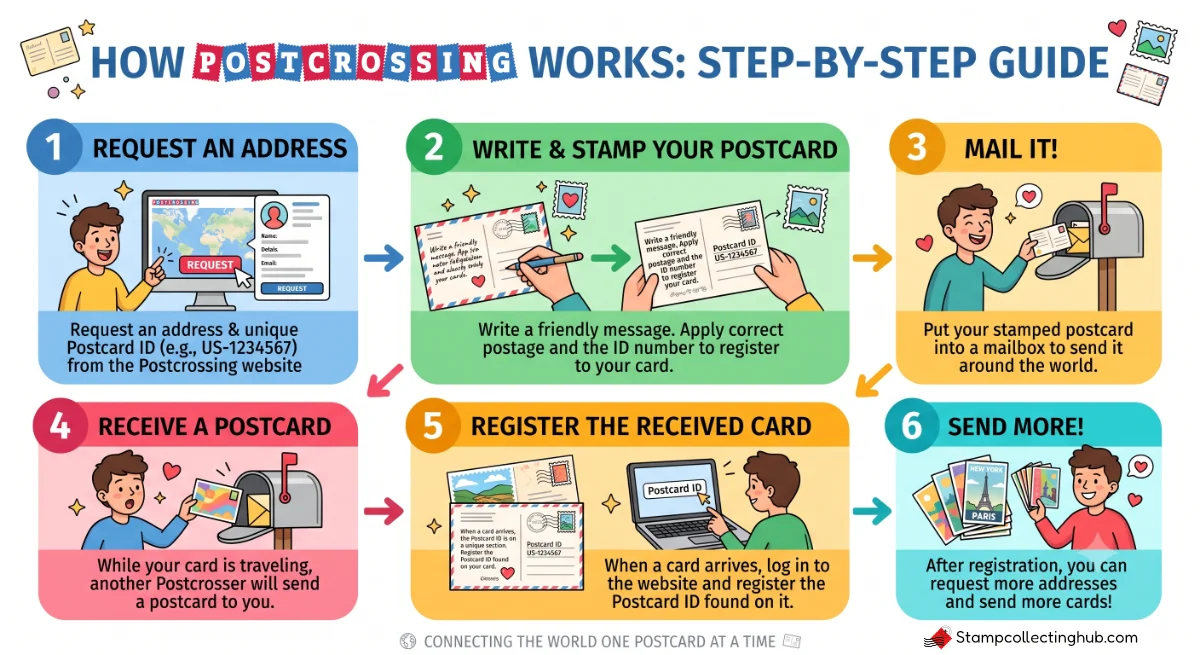
The process is refreshingly simple once you’ve done it once:
- You create a free account at postcrossing.com.
- You request an address. The system gives you the postal address of a random member somewhere in the world, along with a unique tracking code (something like US-123xxx).
- You write and send a postcard to that address. The tracking code goes on the card itself, usually in the corner, so the recipient can register it.
- The recipient registers your postcard when it arrives, using that tracking code. This is what triggers the next step.
- Once your card is registered, your own address is released to a different random member somewhere else in the world, who then sends a postcard to you.
It’s a chain reaction, not a one-to-one trade — you might wait a few days or a few weeks for your card to reach you, depending on where in the world it’s coming from.
Ready to put your stamps to use? Check out our Forever Stamps guide to make sure you’ve got the right postage on hand, or browse our Global Forever Stamps guide before your first international postcard.
How to Join Postcrossing
Joining is straightforward.
Step 1: Create an account: Visit the official Postcrossing website and choose the sign-up option.
Step 2: Complete your profile: Write a short introduction about yourself. You can mention your:
- Hobbies
- Favorite postcard themes
- Favorite places
- Languages
- Stamp-collecting interests
Remember that your profile should describe you rather than function as a list of demands for what another member must send.
Step 3: Request your first address: Once your account is ready, request an address. Postcrossing will provide a random member’s mailing information and your Postcard ID.
Step 4: Send the postcard: Choose a postcard, write your message, clearly add the recipient’s address and Postcard ID, apply the correct postage, and mail it.
Step 5: Wait: This is the hardest part for many beginners. International mail doesn’t always move quickly.
Step 6: Register received postcards: When a postcard arrives in your mailbox, register its Postcard ID on Postcrossing. Then the cycle continues.
What Do You Actually Write on a Postcrossing Postcard?
New members often freeze up here, but it doesn’t need to be complicated. A good Postcrossing postcard usually includes:
- A short greeting and where you’re writing from
- One or two genuine details about your day, your city, or your hobbies
- A question for the recipient, since many people write back once they register your card
- The required tracking code, clearly written
Postcrossing’s own guidelines discourage generic, copy-pasted messages — the whole appeal of the hobby is the personal touch, so even three or four honest sentences go a long way.
Why Postcrossing Is a Natural Fit for Stamp Collectors
If you already collect Forever Stamps or follow USPS releases, Postcrossing gives that interest an outlet beyond just watching new designs get announced:
- You get to actually use interesting stamps, instead of only admiring them. A themed Forever Stamp — say, a wildlife or cultural design — becomes even more fun to send when you know it’s traveling to someone in Germany, Japan, or Brazil.
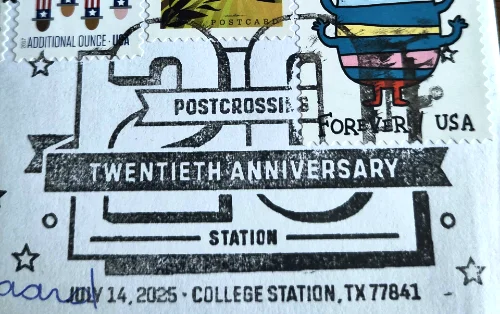
- You receive genuine foreign postage on your incoming cards, often postmarked and cancelled, which many collectors soak, sort, and add straight into their albums.
- It builds a real collection with a story attached — unlike buying stamps from a dealer, every stamp that lands in your mailbox through Postcrossing arrived because a real person, somewhere in the world, chose to write to you.
- It’s a low-pressure way to build a “world stamps” collection without ever ordering from an international dealer.
Postcrossing and U.S. Stamps
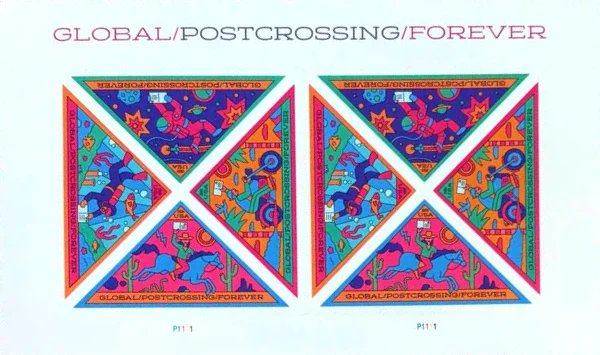
For U.S. collectors, 2026 is an especially interesting year for Postcrossing. On May 26, 2026, the United States Postal Service issued a set of four triangular Postcrossing Global Forever stamps. They were issued in a pane of eight and are intended for the international postage rate.
The USPS says the stamps recognize Postcrossing’s role in encouraging people to send real, personalized mail and connect with people in other countries and cultures. That makes these stamps particularly relevant to collectors who enjoy both Forever Stamps and postcards.
For U.S. Postcrossers, they are also a natural thematic match: you can put an officially issued Postcrossing stamp on a real Postcrossing postcard.
Current Postcrossing Statistics
Postcrossing is now large enough that its statistics are fascinating in their own right. Because the live numbers change constantly, it is better to treat the figures below as a snapshot rather than permanent totals. As of the current September 2026 snapshot, Postcrossing reports:
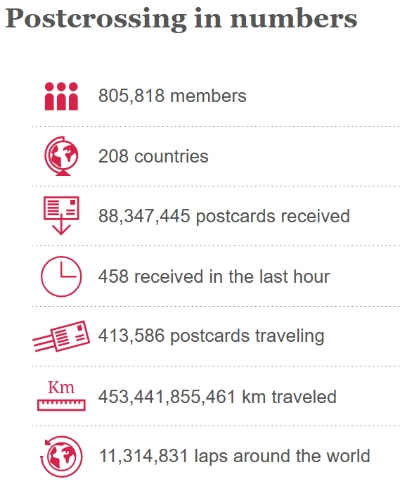
The official statistics pages are live and change as new postcards are sent and received.
Postcrossing statistics for 2025
The project’s annual 2025 statistics provide another interesting look at its scale.
During 2025:
- 4,846,355 postcards were received
- Average travel time was 30.2 days
- Median travel time was 20.2 days
- Postcards traveled about 26.8 billion kilometers
- Postcards were sent from 226 countries and territories
- Postcards were received in 163 countries
- There were 2,329 Postcrossing meetups in 66 countries
October 1, World Postcard Day, was also the busiest sending day of 2025, with 83,069 postcards sent that day.
These figures show that Postcrossing is not just a small postcard hobby. It has become a substantial international postal community.
Postcrossing and World Postcard Day
Postcrossing is also closely associated with World Postcard Day, celebrated each year on October 1. The Postcrossing community helped establish October 1 as World Postcard Day in 2020, following the 150th anniversary of the postcard.
For postcard and stamp collectors, October 1 can be an especially fun day to participate, send a few cards, and pay attention to the stamps and cancellations traveling through the mail.
Tips for Getting the Most Out of Postcrossing
- Keep a small stock of Forever Stamps on hand. Since they never expire in value, you never have to worry about postage rate changes eating into a card you meant to send weeks ago.
- Use the postcard’s address side wisely. Many countries have specific formatting expectations — Postcrossing’s system will show you formatting notes for trickier destinations.
- Register cards you receive promptly. It keeps the whole system moving and is considered good etiquette in the community.
- Join the Postcrossing forum. Members trade tips, share favorite cards, and organize thematic postcard swaps outside the main random system.
- Don’t over-personalize your address requests. Part of the appeal is the randomness — resist the urge to keep requesting until you land somewhere “exciting.”
Sending domestically? Grab a dedicated postcard stamp instead of a Forever Stamp — it’s priced exactly for postcards, so you’re not overpaying by 17¢ every time.
Postcrossing vs. Traditional Pen Pals
Postcrossing is often compared to pen-palling, but the two work differently. A pen pal relationship is one-to-one and ongoing — you write back and forth with the same person over time. Postcrossing is one-to-many and largely anonymous: you’re unlikely to hear from the same sender twice, and there’s no obligation to keep a conversation going. For collectors, that’s actually a feature — it maximizes the variety of stamps, postmarks, and countries you encounter, rather than narrowing your mail to a handful of regular correspondents.
Frequently Asked Questions
Is Postcrossing really free?
Yes. Creating an account and requesting addresses costs nothing. You only pay for the postcards and postage you choose to send.
Do I need special stamps to send a Postcrossing postcard?
No — a standard postcard rate stamp works fine. Many US collectors use their Forever Stamp supply, since postcard-rate and Global Forever options cover both domestic and international sends without needing to check current rates each time.
How long does it take to receive a postcard back?
It varies widely, from about a week for domestic exchanges to several weeks for cards crossing oceans, since it depends on when someone else’s address gets released to another random sender.
Is it safe to share my address?
Postcrossing only shares your address for the purpose of receiving postcards, and the system has run this way securely since 2005. As with any hobby involving your home address, use your own judgment about what you’re comfortable sharing.
Can kids do Postcrossing?
Many families do it together as a geography and writing activity, though a parent or guardian should manage the account and address details for younger children.